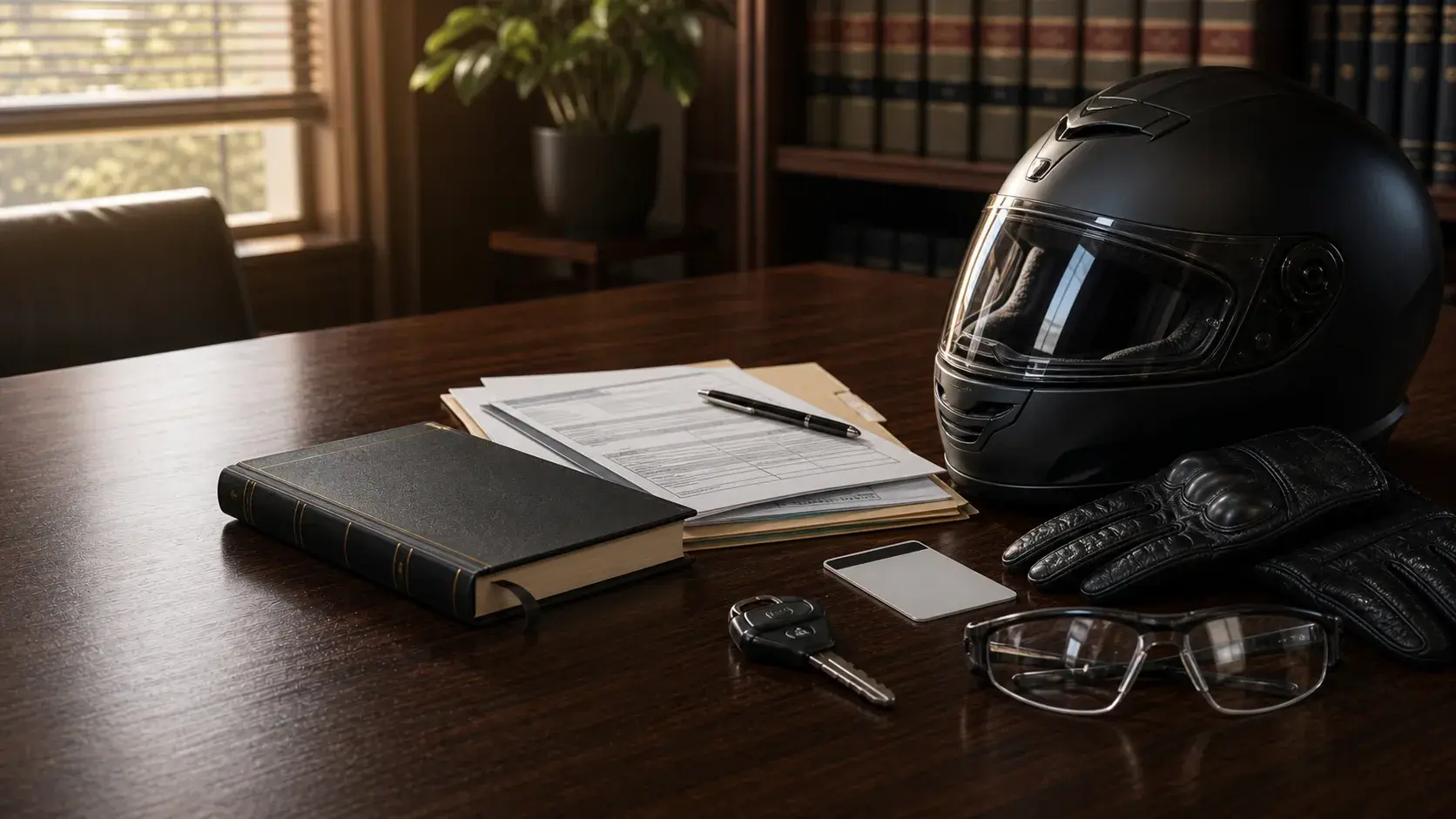
Motorcycle helmet, protective eyewear, gloves, insurance papers, and legal materials arranged on a law office table

Oklahoma motorcycle laws

Oklahoma motorcycle laws riders ask about after a crash.

A rider should not have to sort through government pages, insurance arguments, and internet myths while hurt. Start here for the rules Oklahoma riders ask about most, with official sources and plain crash context.

For accepted motorcycle-injury matters, attorney fees are contingent on recovery and governed by a written engagement agreement.

Find the rule that may matter

The law matters. The facts still matter more.

Insurance companies can turn a motorcycle rule into a blame shortcut. A better review starts with the source, then asks how that rule actually connects to the crash, the injuries, and the proof.

Source checked

July 14, 2026

Motorcycle-law summaries can go stale. The source links stay visible so riders can see where the rules came from.

Endorsement

Motorcycle endorsement and license questions

Oklahoma generally requires the appropriate motorcycle endorsement or learner permit to operate a motorcycle or motor-driven cycle, subject to the permit's restrictions. For a crash review, save the rider's license, permit or endorsement records, and any citation paperwork.

After a crash: A license or endorsement issue may be raised after a crash, but it does not by itself answer who caused the collision. The facts still matter: speed, lookout, lane position, signals, visibility, and avoidability.

Service Oklahoma motorcycle endorsement page

Insurance

Motorcycle liability insurance proof

Service Oklahoma states that liability insurance is required to operate a motorcycle, and Oklahoma's compulsory-security statutes also govern proof of financial responsibility. After a crash, the declarations page matters more than a wallet card because it shows coverage types and limits.

After a crash: Insurance questions can decide whether there is enough money to cover medical bills, wage loss, future care, and wrongful-death damages. Gather motorcycle, household auto, umbrella, and claim-letter paperwork.

Service Oklahoma motorcycle endorsement page

Helmets

Helmet rules for Oklahoma motorcycle riders

Title 47, Section 12-609 requires compliant head protection for motorcycle operators and passengers under 18; it does not impose the same helmet requirement on adults.

In Johnston v. Stacy, the Oklahoma Court of Civil Appeals held helmet nonuse generally inadmissible to prove liability or contributory negligence and, absent contrary legislative or Oklahoma Supreme Court guidance, inadmissible in a damages argument.

After a crash: The decision did not resolve every distinct expert, injury-causation, or mitigation question different facts might present. Preserve the helmet, visor, liner, photographs, medical records, and injury timeline so any specific issue is tied to proof instead of assumption.

Service Oklahoma motorcycle endorsement page

Eye protection

Eye protection and windshield questions

Under 47 O.S. § 12-609(A)(2), a motorcycle operator needs a windshield sufficient to protect against foreign objects or, instead, ANSI Z87.1 goggles or protective eyewear with positive retention, or a protective face shield. Ordinary riding glasses do not satisfy that wording unless they meet the statutory standard and retention requirement.

After a crash: Eye-protection questions usually connect to visibility, roadway debris, weather, and injury arguments. Save the glasses, shield, visor, and bike setup before anything is thrown away or replaced.

Oklahoma Legislature, 47 O.S. § 12-609

Lane splitting

Lane splitting and lane filtering in Oklahoma

Oklahoma does not have a California-style lane-splitting authorization riders should rely on. Title 47, § 11-1103(D) restricts passing between lanes of same-direction traffic, except authorized emergency vehicles.

After a crash: Lane-splitting arguments can become shorthand for blaming the rider. The real review still has to look at lane position, traffic speed, signals, driver lookout, video, witnesses, impact evidence, and current law.

Oklahoma Legislature Title 47 PDF

Passenger and gear proof

Passengers, gear, and post-crash preservation

Passenger injuries, helmets, jackets, gloves, boots, eye protection, phones, cameras, and luggage can all become proof after a serious motorcycle crash.

After a crash: Do not let a tow yard, insurer, repair shop, or well-meaning helper discard the motorcycle or gear before it is photographed and preserved. Physical proof can answer arguments better than memory.

Oklahoma Motorcycle Lawyers preservation tools

How laws show up after a crash

One rule cannot tell the whole crash story.

A serious motorcycle case is built from conduct, causation, injuries, insurance, and proof. A law question belongs in that bigger picture, especially when the rider is being blamed before the facts are known.

Use the crash command center
1

Separate the traffic rule from the crash cause.

A citation, missing document, helmet dispute, or lane-position argument may matter, but it is not the whole case. Fault depends on what each person did and what could have been avoided.

2

Use official sources before internet summaries.

Government pages and statute text are the starting point. Blog posts and quick-answer pages can go stale or leave out the crash context that matters to a rider.

3

Preserve proof before the rule becomes a blame story.

Photographs, video, helmet and gear condition, witness names, insurance letters, medical records, and the motorcycle itself can keep the focus on facts instead of assumptions about riders.

What to save

The paperwork and proof that make law questions clearer.

You do not need every item before asking for help. Use what you can find, and do not throw away the motorcycle, helmet, eye protection, or gear while insurance questions are still open.

Driver license, motorcycle endorsement, and any citation or warning paperwork
Motorcycle insurance card, declarations page, claim letters, and adjuster contact information
Photos of the helmet, visor, eye protection, jacket, gloves, boots, and damaged motorcycle
Police report number, officer name, agency, tow yard, EMS provider, and hospital records
Witness names, business-camera locations, dashcam leads, helmet-cam files, and phone photos
Medical diagnoses, work restrictions, bills, lien letters, and health-insurance explanations of benefits

Common law questions

Oklahoma law questions without turning them into blame.

These answers are general information. A real claim depends on the crash facts, injuries, insurance, venue, and available proof.

Do I need a motorcycle endorsement in Oklahoma?

Oklahoma generally requires the appropriate motorcycle endorsement or learner permit to operate a motorcycle or motor-driven cycle, with restrictions that depend on the credential and rider. If a crash already happened, save the rider's license, permit or endorsement paperwork, and any citation or warning instead of guessing about what it means for the case.

Does Oklahoma require motorcycle helmets?

Title 47, Section 12-609 requires compliant head protection for motorcycle operators and passengers under 18; that section does not impose the same helmet requirement on adults.

Johnston v. Stacy held helmet nonuse generally inadmissible to prove liability or contributory negligence and, absent contrary legislative or Oklahoma Supreme Court guidance, inadmissible in a damages argument. Different facts can still present distinct expert or evidence questions, so preserve the helmet, visor, gear, photographs, and medical records.

Does Oklahoma require eye protection for motorcycle riders?

Yes. Under 47 O.S. § 12-609(A)(2), the operator needs a sufficient windshield or ANSI Z87.1 goggles or protective eyewear with positive retention, or a protective face shield. If eyewear, a visor, debris, glare, rain, or the windshield setup may matter, photograph and save the gear.

Is lane splitting legal in Oklahoma?

Oklahoma does not have a California-style lane-splitting authorization riders should rely on. Title 47, § 11-1103(D) restricts passing between lanes of same-direction traffic, except authorized emergency vehicles. A crash involving lane splitting, lane filtering, or riding between traffic still needs a fact-specific review of the roadway, traffic speed, lane position, driver conduct, witnesses, video, and current law.

Does breaking a motorcycle law automatically mean the rider caused the crash?

No. A traffic-law issue may matter, but it does not automatically answer causation, comparative fault, injury value, or coverage. Serious crash cases still turn on the facts, available proof, injuries, insurance, and venue.