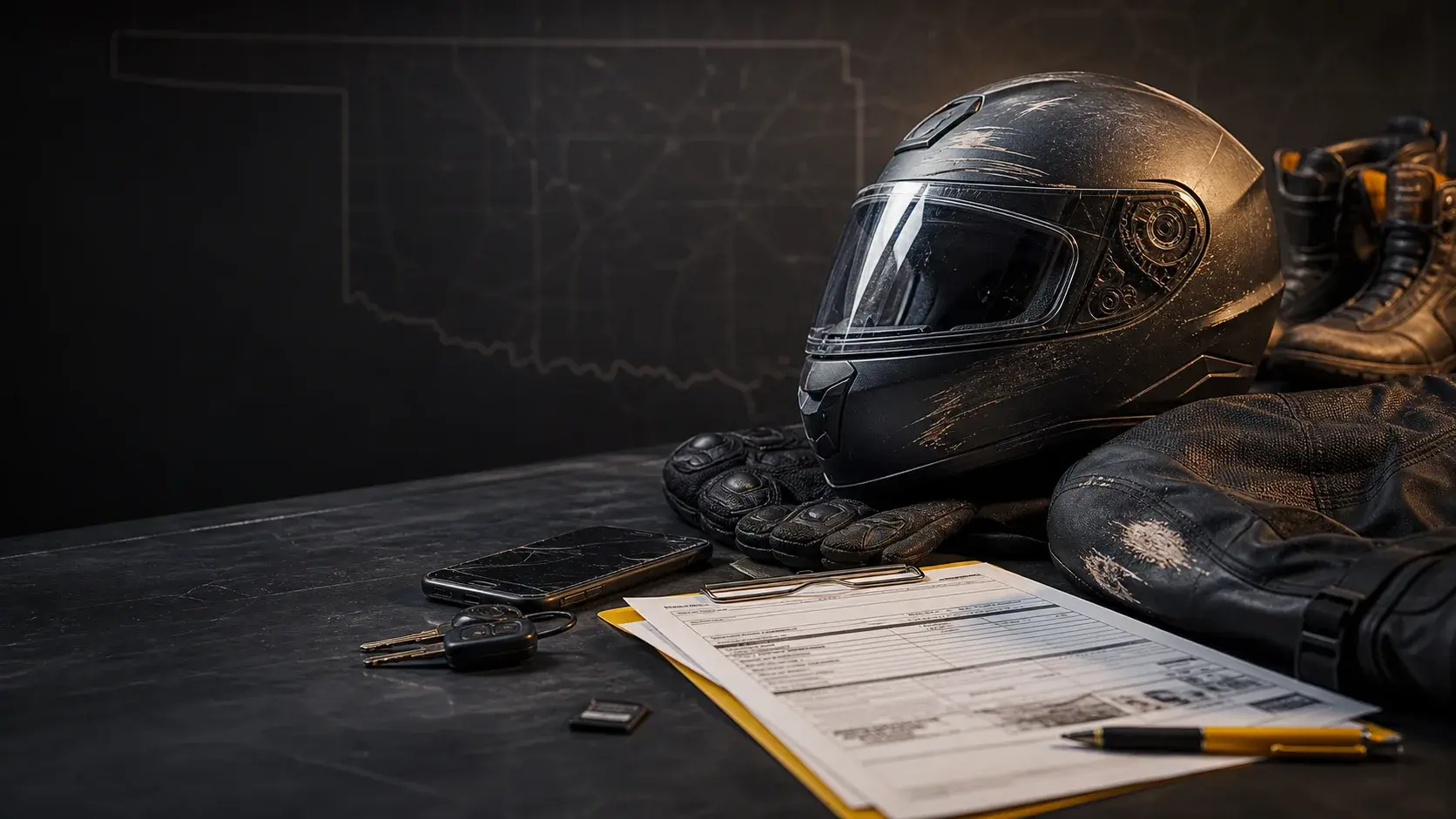
Motorcycle helmet, gloves, damaged riding gear, tow paperwork, and repair documents on a workbench

Bike and property proof

Bike, gear, towing, storage, and total loss after an Oklahoma motorcycle crash

A practical Oklahoma motorcycle crash toolkit for preserving the bike and gear while tracking towing, storage, inspection, repair, valuation, salvage, and insurance paperwork.

For accepted motorcycle-injury matters, attorney fees are contingent on recovery and governed by a written engagement agreement.

Tow-to-disposition custody map

Keep the motorcycle from becoming a moving target.

After a serious crash, the motorcycle may pass from the scene to a wrecker, storage yard, insurer, shop, transport company, auction, or salvage facility. A private custody map keeps access, condition, charges, proposed work, and each handoff connected before the bike or loose items change.

Keep this map private. Rider First's initial case-review form accepts no uploads. Do not place a VIN, title, identification, insurance proof, keys, access codes, personal-property inventory, photographs, or document copies in the first message. If records are later requested, confirm the recipient and channel before sending them.

  1. 1

    Locate the holder and release path

    Confirm the exact facility, inventory number, regular hours, current itemized charges, any law-enforcement hold, and the stated access or release requirements. Oklahoma guidance lists possible ownership, identity, and insurance documents; the holder applies them to the actual request.

  2. 2

    Freeze condition and contents

    Before a permitted move, photograph each side, visible identifiers, controls, tires, lights, loose parts, helmet, gear, keys, and personal property. Record who took the photos, when, where each item was found, and what could not be accessed. Do not enter a restricted area or handle unsafe debris without permission.

  3. 3

    Name the next proposed event

    Ask whether anyone proposes an inspection, start-up, teardown, repair, transport, total-loss transfer, auction, salvage, or disposal. Record the requester, possible authorizer, scope, and stated date. A preservation request is not proof that a holder agreed, charges stopped, or every proposed action is prohibited.

  4. 4

    Close every handoff in writing

    For each move or access event, keep the date, origin, destination, carrier, receiver, condition notes, inventory, authorization, receipt, and signed document. Keep a tow release, title or power-of-attorney document, property payment, and injury release on separate lines until each purpose and effect are understood.

Fields for a private custody map

  • Motorcycle or item
  • Current holder and location
  • Access or release requirement
  • Next proposed event
  • Requester and authorizer
  • Date, source, and status

This map does not decide ownership, release authority, a law-enforcement hold, a wrecker charge, a lien, a sale or disposal date, coverage, payment responsibility, a document's effect, the need for an inspection, or representation. Confirm current requirements with the actual holder, agency, insurer, lienholder, qualified professional, or counsel as needed.

Insurance call language

A careful way to slow the property-damage call down.

A careful first response can be simple: "Please send the estimate, valuation, photos, and any release you want signed by email. I am preserving the motorcycle and gear and need to understand what this paperwork covers before I sign anything."

Documents to gather.

  • Photos of the bike, VIN, odometer, impact points, and all damaged gear.
  • Tow invoice, storage notices, repair estimates, total-loss valuation, and title paperwork.
  • Receipts for helmet, gear, accessories, custom parts, camera equipment, and recent work.
  • Insurance emails, payment letters, releases, claim numbers, and adjuster contact information.
  • Police report, witness names, scene photos, and any video source tied to the motorcycle or gear.

Evidence preservation only

When a part failure or recent repair may matter.

A broken part, tire condition, warning light, or recent shop visit may identify records and physical evidence worth preserving. It does not by itself prove a defect, cause of the crash, or that Rider First will accept a product, repair, or service-related matter.

  • Preserve the motorcycle and affected parts before teardown, repair, salvage, disposal, or destructive inspection. Photograph their condition and record who has custody.
  • Retain service and repair orders, estimates, invoices, technician notes, parts packaging and numbers, tire purchase and installation records, warning-light photos, pre-crash and post-crash photos, and communications with shops, sellers, manufacturers, insurers, tow yards, and salvage facilities.
  • Keep a dated custody record showing where the motorcycle and parts were stored, moved, inspected, or transferred and by whom.
  • A NHTSA VIN or recall lookup can be an investigation lead. A match or search result is not proof that a part failed, caused the crash, or was within any repair provider's service scope.

Private repair-history map

Connect the service record to the part—without assuming the answer.

When a warning, handling change, tire issue, loss of power, recent repair, or replaced component may matter, build a dated record before the motorcycle or parts change. The useful question is what was observed, requested, done, installed, removed, and preserved—not whether a database result supplies the cause.

Keep this record private. Rider First's initial form accepts no uploads. Keep VINs, plates, registrations, invoices, warranty records, technician notes, photographs, account credentials, and complaint drafts out of the first message. Use official NHTSA tools directly and confirm any later recipient and channel before sharing records.

  1. 1

    Freeze the reported condition

    Write the rider's own pre-crash observation without adding a diagnosis. Keep the date, approximate mileage if known, warning display or sound, handling or power change, photographs, messages, and the person who received the report. Preserve uncertainty when timing or wording is not known.

  2. 2

    Rebuild each service episode

    For every shop, seller, installer, or owner visit, separate the condition reported, work requested, inspection documented, work actually recorded, parts identified, and later change. Keep estimates, repair orders, invoices, technician notes, warranty records, and communications as distinct documents.

  3. 3

    Keep part identity and custody

    Before permitted teardown or testing, photograph the motorcycle, affected area, labels, packaging, and visible identifiers. Record who removed, stored, inspected, or returned each part. Leave damaged equipment uncleaned, unpowered, assembled, and untested unless permission and qualified safety guidance support a change.

  4. 4

    Read safety databases as leads

    Record the exact search type, date, vehicle or equipment description, and result. A VIN result can omit completed, older, recent, small-manufacturer, non-safety, or international campaigns. A recall, complaint, investigation, or manufacturer communication may justify questions; it does not prove applicability or causation.

Fields for a private repair-history map

  • Service episode or item
  • Reported condition
  • Requested work
  • Documented work or part
  • Holder and custody status
  • Open question and source

This record does not identify a defect, negligent repair, recall applicability, failed remedy, crash cause, legal duty, deadline, product claim, or representation. A database match and a no-match result both have limits. Preserve the machine and source records, then use the actual documents and qualified case-specific review for any inspection or conclusion.

Questions

Questions riders ask when the bike, helmet, or gear is damaged.

Why does bike and gear damage matter in an injury case?

Their condition may help a qualified investigator or expert evaluate contact points, impact direction, road contact, visibility, and possible injury mechanisms. The items do not establish speed, force, fault, medical causation, or case value by themselves.

Should I accept a total-loss offer on the motorcycle?

Do not treat the bike as only a property issue until it is documented. Save the valuation, photos, release language, title paperwork, and all messages so the property process does not erase proof.

Who pays tow and storage charges?

That depends on the facts, coverage, contracts, property process, and claim handling. Get itemized charges and written instructions, track the dates, and do not assume a verbal promise resolves responsibility.

Is this a promise to handle only my property-damage claim?

No. This toolkit is general education and does not promise that any matter or property-only task will be accepted. Any representation would require a written agreement identifying responsible counsel and scope.