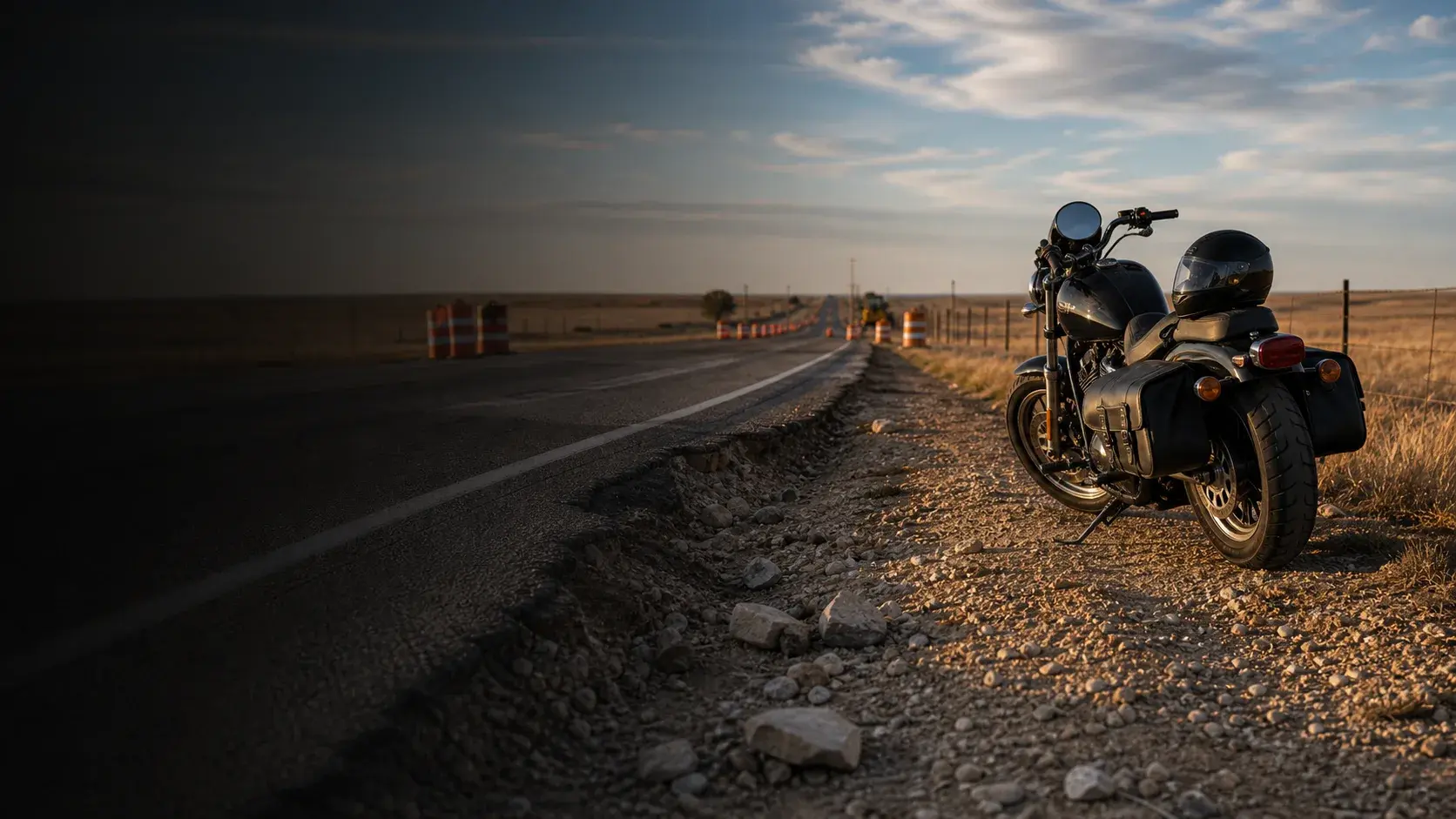
Oklahoma road shoulder with gravel, construction barrels, and a motorcycle parked safely off the roadway

Gravel, debris, shoulders, construction

Oklahoma road hazard motorcycle crashes

Oklahoma road hazard motorcycle crash guidance for gravel, debris, unsafe shoulders, construction zones, poor lighting, and roadway evidence.

For accepted motorcycle-injury matters, attorney fees are contingent on recovery and governed by a written engagement agreement.

Condition, control, and notice

What to save for road hazard crashes.

Road hazards can be swept, repaired, moved, washed away, or hidden by later traffic. Show the condition from the rider's approach and identify who created, controlled, inspected, or received notice of it before assuming the road itself explains responsibility.

Photos of gravel, debris, fluid, potholes, edge drop-offs, lighting, shoulders, signs, and barrels

Wide scene photos showing where the hazard was compared to lanes, curves, ramps, and sight lines

Police, EMS, tow, maintenance, work-zone, contractor, and roadway-agency records

Witnesses who saw the hazard before, during, or after the crash

Motorcycle, tire, wheel, suspension, helmet, gear, and body-contact evidence

Official process and practical proof

Build the road-condition file before the roadway changes.

A road-hazard file becomes more reliable when four questions stay separate: where the condition was, who controlled that part of the road, which office may hold each record, and whether a different legal-notice path applies. Oklahoma routes state highways, local roads, turnpikes, collision reports, and public-entity claims differently. Connect those paths only after the facts support it.

Step 1

Give the location an agency can recognize

Record the route or street name, direction, lane or shoulder, nearest intersection, exit or mile marker, city and county, date and time, and a map or photograph showing the approach. ODOT asks for the highway number, county, relevant maps, project number if known, and date period. Precision helps route a request; it does not prove who controlled the condition.

Step 2

Separate the road, signal, turnpike, and work zone

ODOT's records page limits its form to ODOT-related State Highway and Bridge information and sends city or county street and bridge information to those local offices. Its FAQ separately says turnpikes are operated elsewhere and cities or counties maintain traffic signals, including on state or U.S. highways. Keep the road, signal, contractor, and police agency separate until records show their roles.

Step 3

Split crash records from road records

Service Oklahoma handles collision reports. DPS separates OHP CAD and vehicle-examination records from body, dash, or 911 requests and directs other-agency reports to that agency. Road-condition records require a different request to the actual road or signal custodian. Define the segment and date period without assuming any complaint, inspection, repair, project, or contractor record exists or is public.

Step 4

Keep the request trail and legal-notice path separate

Keep each request, receipt, response, attachment, and referral. A maintenance report, records request, or collision-report request does not itself establish compliance with the written governmental-claim requirements in 51 O.S. Section 156 or protect a deadline. Entity, notice, timing, and preservation questions require prompt case-specific review. Never reenter an active road or work zone to collect more proof.

Questions that matter in road hazard crashes.

Photograph before the road changes

Hazards can be swept, repaired, moved, washed away, or covered quickly. Photos from multiple distances and angles can preserve what the roadway looked like.

Identify who controlled the condition

A road-hazard case may involve a driver, contractor, property owner, city, county, state agency, or other entity. The answer depends on the exact facts.

Do not ignore rider bias

Insurers may say the rider simply lost control. The motorcycle, road, scene photos, witnesses, and maintenance records may tell a different story.

Coverage questions after road hazard crashes.

Possible responsibility may involve another driver, a contractor, a property owner, or a government entity, but each requires a factual and legal basis. Preserve insurance information while separately identifying the road authority, work zone, or commercial actor actually connected to the condition.

  • Liability coverage for drivers who caused or contributed to the hazard
  • Commercial, contractor, property-owner, or government-related coverage depending on facts
  • UM/UIM coverage if another vehicle caused the hazard and cannot be identified
  • Health insurance, liens, wage loss, and property paperwork
Review coverage issues

Questions

Questions about road hazard crashes.

These answers are general information. A real claim depends on the crash facts, injuries, insurance, venue, deadlines, and available proof.

Can loose gravel or debris support a motorcycle crash claim?

It can, depending on what caused the hazard, who controlled the area, what notice existed, and what proof remains. Photos and records matter early.

What should I photograph after a road-hazard motorcycle crash?

Photograph the hazard, lane, shoulder, signs, cones, barrels, lighting, sight lines, skid marks, debris, motorcycle damage, gear, and the approach from each direction.

Are road-hazard claims different if a government road is involved?

They can be. Government-related claims may involve special records and deadlines. The exact location and responsible entity should be checked quickly.

Next steps

Describe what made the road unsafe.

Share the exact location and approach, what made the roadway unsafe, photographs or witnesses, construction or maintenance clues, responding agency, motorcycle and tire location, and any notice already sent.

For accepted motorcycle-injury matters, attorney fees are contingent on recovery and governed by a written engagement agreement.

Request a case review