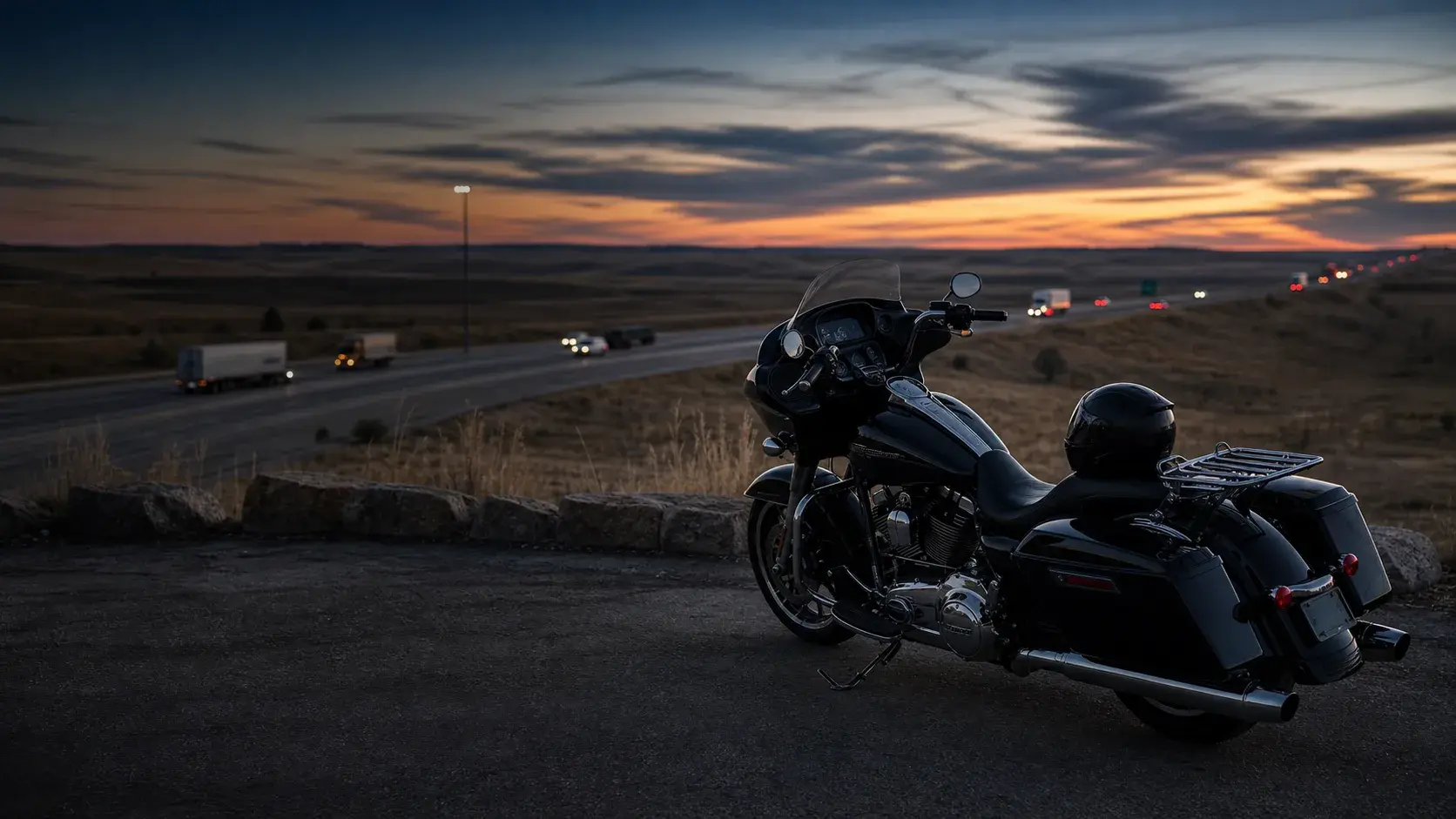
Oklahoma highway at dusk with a motorcycle parked safely on a wide paved overlook away from traffic

I-35, I-40, I-44, turnpikes, highways

Oklahoma highway and interstate motorcycle crashes

Oklahoma highway and interstate motorcycle crash help for tracing the event sequence, finding records, and sorting roadway, vehicle, and coverage questions.

For accepted motorcycle-injury matters, attorney fees are contingent on recovery and governed by a written engagement agreement.

The road, movement, and event chain

What to save for highway and interstate crashes.

A highway crash may unfold across a merge, the first change in the motorcycle's path or stability, one or more contacts, rider separation, and different final positions. Medical care comes first. Use existing records and lawfully obtained sources to keep those events separate; never return to active traffic to document the scene.

Mile marker, direction of travel, lane, shoulder, ramp, and nearest exit

Original photos or video with their source, time information, full frame, and transfer history preserved

Separate rider, motorcycle, and vehicle positions, damage, debris, scrape or tire marks, and first final-rest locations

Witness locations and the movement, contact, sound, or condition each person actually observed

Responder, tow, vehicle, company, roadway, or camera clues tied to a known event, without assuming a record exists

Official process and practical proof

Trace the highway crash as an event chain.

Oklahoma's current collision-report manual separately records the crash-level location of the first damage- or injury-producing event and, for each unit, a pre-crash action, a most harmful event, and up to six ordered events. That reporting structure can help check an account; an officer's selections cannot by themselves decide civil fault, legal causation, injury mechanism, or insurance coverage.

Step 1

Fix the road segment safely

Use the report number, original photos, messages, trip record, tow paperwork, or witnesses to identify the highway, direction, nearest exit or mile marker, lane, ramp or shoulder, date, and time. Never enter, stop on, or return to active traffic, trespass, approach an unsafe vehicle, or delay medical care to document the scene. Precision helps match possible sources; it does not establish roadway control or fault.

Step 2

Separate the last stable movement

Record what each source shows before damage or injury: lane position, merging, braking, evasive movement, road departure, cargo, debris, or another observed condition. Note the first event an identified source itself connects to observed damage or injury; if no source does, leave that point unknown. A suspected trigger, no-contact vehicle, or evasive response does not establish fault or legal causation by itself.

Step 3

Continue every unit through later contacts

Keep the rider, motorcycle, and each involved vehicle on separate lines. Record each known vehicle, barrier, object, roadway, rider, or motorcycle contact and where the rider, motorcycle, gear, and vehicles first came to rest before responders, traffic, towing, or recovery changed the scene. Never assign an injury, damage item, or share of responsibility to one contact without qualified support.

Step 4

Compare sources without collapsing them

Keep the personal event map separate from the collision report's event fields, diagram, and narrative and from original video, photographs, witness accounts, tow records, and vehicle evidence. Preserve disagreements and missing segments instead of forcing the sources into one story. A report, citation, diagram, missing record, or unavailable media does not decide civil fault or protect a deadline.

Questions that matter in highway and interstate crashes.

The sequence, not a speed shortcut

Highway cases should not be reduced to an assumption about speed. Start with observable movement—lane position, merging, braking, encroachment, debris, road departure, or loss of stability—then keep later contacts and final positions in order.

A separate line for every unit

The rider, motorcycle, and each car, truck, trailer, object, or no-contact vehicle need separate tracks. A nearby vehicle is not part of the event chain unless a source supports its role, and the first path change is not automatically proof of legal causation.

Every event needs a source label

Label whether each fact came from personal memory, a witness, original media, physical evidence, an official record, or later analysis. Preserve conflicts and unknowns rather than forcing one account or treating a source category as proof that data was created, retained, accessible, or reliable.

Coverage questions after highway and interstate crashes.

A highway crash can involve a driver, vehicle owner, employer, motor carrier, contractor, or an unidentified vehicle. Match each possible source to actual facts and policy documents rather than assuming every commercial policy applies.

  • Liability coverage for drivers, commercial vehicles, employers, and vehicle owners
  • Uninsured or underinsured motorist coverage if a driver is missing or underinsured
  • Med-pay, health insurance, disability coverage, and lien paperwork
  • Separate property paperwork for the motorcycle, gear, tow yard, and total-loss process
Review coverage issues

Questions

Questions about highway and interstate crashes.

These answers are general information. A real claim depends on the crash facts, injuries, insurance, venue, deadlines, and available proof.

Why are highway motorcycle crashes different?

The rider, motorcycle, and other vehicles can follow different paths after the first destabilizing movement. Merges, road departures, later contacts, and separated final positions make an event-by-event account more useful than a single-impact summary.

What if a truck or commercial vehicle was nearby?

Record the company name, vehicle number, trailer markings, plate, direction of travel, and any known camera or data clue. A company or device name does not mean relevant information was created, retained, accessible, or reliable; connect each possible source to an event before drawing a conclusion.

Can roadway conditions matter?

Yes. Debris, gravel, construction, missing signs, unsafe shoulders, poor lighting, and lane defects can matter, depending on who controlled the road and what evidence exists.

Next steps

Share the highway sequence you know.

For an Oklahoma motorcycle injury matter, share the highway and direction, nearest exit or mile marker, the first event known, later contacts, first final positions, responder and tow basics, and known company or source-holder names. The initial form accepts no uploads; keep medical files, insurance or government identifiers, witness contact details, original media, and device data out of the first message.

For accepted motorcycle-injury matters, attorney fees are contingent on recovery and governed by a written engagement agreement.

Request a case review