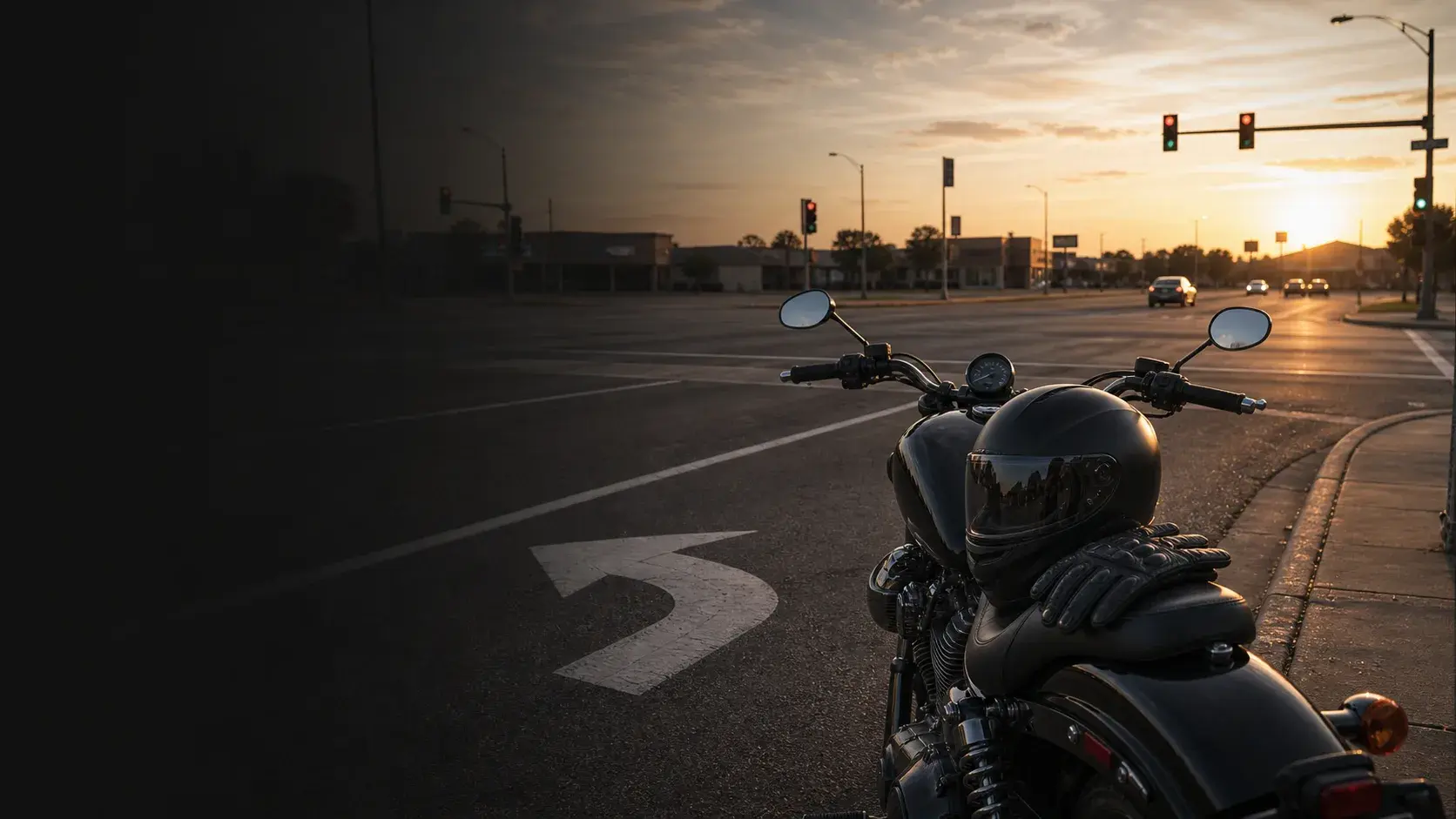
Oklahoma intersection at sunrise with a motorcycle stopped safely and a turning lane visible

Driver turned across the rider

Left-turn motorcycle crashes in Oklahoma

Oklahoma left-turn motorcycle crash help for riders hit by a driver turning across their lane, with evidence, insurance, and next-step guidance.

For accepted motorcycle-injury matters, attorney fees are contingent on recovery and governed by a written engagement agreement.

Movement and visibility

What to save for left-turn crashes.

The decisive question is often whether the turning driver had a fair opportunity to see the motorcycle before crossing its path. Preserve the approach, the turn, and the physical contact before those facts are reduced to competing recollections.

Photos of the intersection, turn lane, signal heads, lane markings, and sight lines

Vehicle damage on the motorcycle and turning vehicle

Witness names, phone numbers, and where each witness was standing or driving

Nearby business, traffic, dashcam, doorbell, bus, or fleet video

911 audio, police report, bodycam, dashcam, and scene measurements when available

Official process and practical proof

Build the left-turn decision from the rule and the movement proof.

Oklahoma's left-turn provision generally requires a driver intending to turn left within an intersection, alley, private road, or driveway to yield to oncoming traffic that is close enough to present an immediate hazard. That rule does not make liability automatic; the sequence, visibility, timing, traffic control, and physical evidence still require case-specific review.

Step 1

Map the point of conflict

Photograph each approach, the turn lane or driveway, signal heads and signs, lane markings, sight obstructions, lighting, impact area, debris, and final positions. Record where the motorcycle first became visible and where the turning vehicle began moving, without guessing about speed or distance.

Step 2

Create a neutral turn timeline

List the traffic phase or gap, signal use, turn start, motorcycle approach, braking or evasive movement, impact location, and witness viewpoints. Compare that timeline with damage angles, video, scene measurements, and the driver's own account.

Step 3

Ask for existing signal and agency records precisely

Identify the responding agency and the government entity responsible for the intersection. A focused request can ask whether responsive timing plans, phase information, diagrams, maintenance or work-order records, photographs, supplements, or responding-unit media exist. Do not imply that every intersection creates or retains each category.

Step 4

Preserve the original visibility proof

Keep original video, photographs, helmet or bike-camera files, the motorcycle, headlight and lighting evidence, helmet, and gear. Save the delivery message or other provenance for each file and avoid editing the only copy.

Questions that matter in left-turn crashes.

What the driver could see

A left-turn case should be built around visibility, not assumptions. Lighting, road geometry, traffic gaps, headlight use, vehicle height, and where the motorcycle was before impact can all matter.

The turn itself

Turn timing, turn speed, signal use, lane choice, and whether the driver cut across the rider's path help answer whether the crash was avoidable.

The rider-blame shortcut

Speed and lane-position assertions should be tested against physical evidence instead of accepted from a rushed phone call. Helmet nonuse is not a general shortcut to rider fault under Johnston v. Stacy.

Coverage questions after left-turn crashes.

Begin with the turning vehicle, then check whether an employer, delivery platform, vehicle owner, household policy, or the rider's UM/UIM coverage belongs in the analysis. Keep property paperwork separate from any injury release.

  • The turning driver's liability coverage
  • The rider's uninsured or underinsured motorist coverage if the driver has too little coverage
  • Health insurance, medical-payment coverage, liens, and wage-loss proof
  • Any commercial, rideshare, delivery, employer, or household policy that may be involved
Review coverage issues

Questions

Questions about left-turn crashes.

These answers are general information. A real claim depends on the crash facts, injuries, insurance, venue, deadlines, and available proof.

Is a left-turn motorcycle crash automatically the turning driver's fault?

No crash should be treated as automatic. The key questions include right of way, what the driver could see, signal timing, lane position, speed evidence, and whether the turn cut across the rider's path.

What if the driver says they never saw the motorcycle?

That statement may show why the crash happened, but it does not decide the case. The driver still may have had time, distance, lighting, and sight lines that should have revealed the motorcycle.

What should I save after a left-turn crash?

Save photos, witness names, helmet and gear, the motorcycle, insurance messages, medical records, repair paperwork, police information, and any nearby camera locations.

Next steps

Describe how the driver crossed your lane.

Share the intersection or driveway, direction of travel, traffic control, where the turn began, impact location, witnesses, camera clues, and where the motorcycle is being held.

For accepted motorcycle-injury matters, attorney fees are contingent on recovery and governed by a written engagement agreement.

Request a case review